Tuesday, May 21, 2013

28mm Imperial Romans - Warlord Games

So I'm moving to a new apartment this month, and it turns out that, besides the demands of a day job, few things can eat in to one's painting time more effectively than having to pack up all one's possessions and relocate them. I've not got much else done this month, but I wanted to get at least some pictures up, so here are some 28mm Imperial Romans from Warlord Games, which I painted for a private collector.

The shields are done with the transfers supplied with the set, which proved a little trickier than anticipated. The fit was good and they were easy to remove from their backings after soaking in water, but they did not want to adhere well to the shields themselves, the edges curling up as they dried. I tackled this problem by brushing on clear matt varnish, which both seeped under the transfer and held it in place, and took care of the glossy sheen.

Just 8 of them for now, but there will be more in the near future.


Friday, April 26, 2013

Auctioning off a ship: 1:300 Langton Miniatures Brig [EDIT: SOLD]

This is a model that I completed and posted to my blog some time ago, but in an effort to clear space in my over-crowded Brooklyn apartment I've decided to auction it off on Ebay.

It's an English brig from the period of the Napoleonic wars, and features crew members on deck and in the rigging, a painted sea base, MDF pedestal and a fitted plexiglass cover that can be removed.

If it turns out there is a market for this sort of thing (I've never tried it before!) then a few other similar models may follow.

The auction can be found here:

http://www.ebay.com/itm/1-300-scale-Model-Ship-Langton-Miniatures-Brig/221219374315?ssPageName=WDVW&rd=1&ih=012&category=4248&cmd=ViewItem

Take a look if you're interested in this sort of thing! - James


Tuesday, April 9, 2013

28mm Cataphracts Command - Relic Miniatures

In the course of their eastern conquests the Macedonians encountered very heavy cavalry of a type used for generations in Persia, and which the Greeks called "kataphractoi", meaning "completely enclosed". Not only were the riders themselves covered from head to toe in heavy bronze armor, but their horses as well were similarly protected. Recognizing a powerful tool, the Seleucids especially incorporated these units into their forces.

Cataphract cavalry were slow moving but extremely powerful, well suited not only to breaking the strongpoints of the enemy's line of battle with a momentous charge, but also to remaining in close combat, protected by their extensive armor, where other cavalry would have been put at a great disadvantage by masses of infantry.

These figures are 28mm models from Relic Miniatures, and are fantastically detailed with ornate helmets and many, many-pieced suits of armor. The standard bearer wears a metal face mask. The standard itself is part decal (the wreath element I cut from a LBM transfer) and part freehand (the eight-rayed sun and the border lines).


Thursday, March 21, 2013

Onboard the USS Constitution

Recently I had the great good fortune to make a pilgrimage to Boston for the sake of going aboard USS Constitution. I had talked about the subject for so long that, no doubt unable to listen to me go on about it any longer, my girlfriend made a belated christmas present out of the vacation. We took the train up on a Thursday morning, and spent several days touring the historical sites and wandering around the commercial districts, returning on Sunday. The best hotel deal we found was at the Harborside Inn on State street. I'd recommend the place, it was clean and comfortable and conveniently located. And better stil, there is a lovely model of the Constitution in the lobby by the elevators. If you look hard you can just see the reflection of my girlfriend Lysa looking - inexplicably - unimpressed. (She was actually an incredibly good, cheerful enthusiastic travelling companion the whole time, but I do like to tease her).

The day we arrived we went to the Boston Tea Party Museum. I confess to being attracted principally by the replica merchant ships one can go aboard there:


On board, a very congenial mannequin captain will allow you to snoop around in his cabin. Very hospitable of him, I think, especially since he is clearly pressed with paperwork.


On Friday morning we set out on the Freedom Trail itself, an actual trail or line, sometimes in red brick and sometimes in paint, that begins at Boston Common and winds its way through the city taking tourists to various sites of historical interest. We enjoyed this a lot, and many pictures were taken. However in the interest of space I'm going to confine myself in this post to ship-related imagery.

At the end of the Freedom Trail (I'd say it took us between four and five hours to get there, at our leisurely pace and stopping for lunch) one reaches the real destination. This was my first good shot of the ship, seen through the gaps in a chain fence. You can see that the topgallant masts are lowered down onto the tops. At this point I was beaming like a child, an expression that apparently didn't leave my face the entire time.


USS Constitution seen from the starboard side on a sunny winter's day:


The genuine smashers - carronades on the quarterdeck:


Down below, on the main gun deck now. At this position (port side, just in front of the captain's cabin) a friendly sailor is stationed by a display of different sorts of ammunition, and he will talk to you about the weaponry or whatever you'd like to pick his brain about. It was neat to listen to him speak of how the crew would respond to different situations in the first person plural: "if we could come into close range we would try to clear their decks with grape shot, which you see here." It's not just a museum ship, the crew consider themselves part of the living tradition of the ship and the men who served on her in her relative youth.


 Looking forward along the port side battery on the main gun deck. You can see that they are currently doing renovation work on the ship, which sadly meant that we couldn't go below this deck.


Inside the first of the captain's several cabins now.


And here is the bed on the starboard side, behind the room shown above. This is a mirror image of the same accommodation found on the port side. If memory serves, in between was another room we were not allowed to enter. I may be misremembering that though.


Here is the view looking forward along the port side of the ship, from the quarter gallery.


And back up top again, looking forward along the port side of the deck. 


Looking up at the dizzying heights of the masts. And these aren't even extended to their full height, as noted earlier. They would be a good deal taller with the topgallant masts were raised. Just imagine climbing the ratlines while the ship was swaying wildly in severe weather on a tossing sea.


I never cease to marvel at the intricacy of the rigging. 


At the bow of the ship, the bowsprit itself. Note the steps leading up its length, with a line on either side for safety.


Saying goodbye to the ship. A view across the water at the port side. The next day we walked all the way back to be able to go through the USS Constitution museum, which will tell you about the history of the ship and the men who served on her, as well as giving a lot of general information about life at sea at the time. And there are a great deal of ship models in it.


I can't tell you how much fun it was to be on board such a famous vessel from such a fascinating era in the nation's history, in world history. Lysa was kind enough to document my goofy grin. I'm wearing it again as I look through these pictures.


Wednesday, March 20, 2013

More of Hannibal's Veterans - Relic 28mm

As a further step toward liberating Italy from the overreaching Romans, and restoring a rightful order to the Mediterranean world, I have added 4 more Carthaginian veterans from Relic Miniatures (28mm) to the unit. As many of you are already aware, after his initial victories in Italy Hannibal equipped many of his men with captured Roman equipment, so these gentlemen wear Roman chain mail, two Roman helmets, and all of them sport large Roman shields, or "scuta".

I've hand-painted the shields with a variety of Carthaginian symbols - except for the second from the left. His has retained a Roman design to make the origin of the equipment all the more obvious - and hopefully giving just a little bit of a taunt to their opponents.

Tuesday, March 5, 2013

HMS Cleopatra - GHQ 1:1200

The latest project out of the shipyards is GHQ's 1:1200 model of HMS Cleopatra, a 32 gun frigate. I have made a few modifications to the kit to add some detail and make it more to my taste. I have raised the hull slightly on plastic sheeting, replaced the extremely flimsy bowsprit with a steel rod (retaining the GHQ sails) and added Langton ratlines and sea base. I've also added the spritsail yard and dolphin striker to the bowsprit (using brass rods), since GHQ does not incude those details. I've mounted it on a black plastic base (from Lithko) and glued magnetic sheeting to the bottom of that, so it can be more securely stored and transported in a steel sheet-lined box.

So what is Cleopatra's story? Forgive me as I copy Wikipedia's entry on the ship:

HMS Cleopatra was a 32-gun Amazon-class fifth rate frigate of the Royal Navy. She had a long career, seeing service during the Fourth Anglo-Dutch War and the French Revolutionary and Napoleonic Wars. During the latter wars she fought two notable engagements with larger French opponents. In the first engagement she was forced to surrender, but succeeded in damaging the French ship so badly that she was captured several days later, while the Cleopatra was retaken. In the second she forced the surrender of a 40-gun frigate. After serving under several notable commanders she was broken up towards the end of the Napoleonic Wars.

Cleopatra was ordered on 13 May 1778 and was laid down on 6 July 1778 at the yards of James Martin Hillhouse, Bristol. She was launched on 26 November 1779 and had been completed by 9 September 1780. £9,202 (approximately £980 thousand at today's prices) was paid to the builder, with another £5,563.1.5d (approximately £590 thousand at today's prices) spent on dockyard expenditures. Cleopatra was commissioned in October 1779 under her first commander, Captain George Murray.


Cleopatra was initially assigned to serve with the Western squadron and was soon active in activities to suppress French cruisers and privateers. On 15 June 1780 Cleopatra and HMS Apollo captured the 26-gun Stanisland off Ostend; while the privateer Comtesse de Provence fell to Cleopatra on 11 November 1780. Cleopatra escorted a convoy to the Baltic on 1781, becoming involved in the Battle of Dogger Bank on 5 August. She passed under the command of Captain Henry Harvey in January 1783, but was paid off in April that year and fitted for ordinary at Sheerness. She remained laid up until 1790 when she began a Great Repair, and was recommissioned in January 1793 under Captain Alexander Ball.


Cleopatra continued her effective career against raiders by capturing the privateer Trois Amis on 24 March 1793 in company with HMS Lizard. She was operating from Nova Scotia from 1794, and was under Captain Charles Penrose in June 1795. He took the privateer Aurore on 3 March 1796, before passing command to Captain Charles Rowley, who coincidentally took another French ship named Aurore on 22 April that year. Rowley went on to capture the 12-gun privateer Hirondelle during his tenure, before Captain Israel Pellew took over command of the Cleopatra in September 1797. Pellew served briefly in the English Channel, taking the 16-gun privateer Emilie on 26 March 1798. He then returned the Cleopatra to Halifax in August that year. She operated off the American coasts, ranging as far as the Caribbean and Cuba, where she and HMS Andromache captured a Spanish gunboat on 22 March 1801. Pellew then returned the Cleopatra to Britain, where she spent between 1802 and 1804 under repair at Woolwich, recommissioning in July 1804 under Captain Charles Elphinstone. Elphinstone's tenure lasted less than a month, and by August Cleopatra was sailing under Captain Sir Robert Laurie.


Cleopatra spent some time in the West Indies and was homeward bound in February 1805. While sailing off Bermuda Cleopatra sighted a sail--the 40-gun French frigate Ville de Milan. She had sailed from Martinique on 28 January under Captain Jean-Marie Renaud and was bound for France with several important dispatches. Despite identifying his quarry as a superior opponent, Laurie ordered a chase. Renaud had orders to avoid combat and pressed on sail to escape Laurie. The chase covered 180 miles and lasted until the following morning, when Renaud reluctantly came about to meet the Cleopatra, which was overhauling the Ville de Milan. The engagement began in earnest at 2:30pm, and a heavy cannonade was maintained between the two frigates until 5pm, when the Cleopatra had her wheel shot away and her rudder jammed. The Ville de Milan approached from windward and ran aboard the Cleopatra, jamming her bowsprit over the quarterdeck while raking the Cleopatra's decks with musket fire. The British resisted one attempt to board, but on being unable to break free, were forced to surrender to a second boarding party. The Cleopatra had 22 killed and 36 wounded, with the loss of her foremast, mainmast and bowsprit. The Ville de Milan probably had about 30 killed and wounded, with Captain Renaud among the dead. She also lost her mainmast and mizzenmast. Three days were spent transferring a prize crew and prisoners, and patching up the ships, before the two got underway on 21 February.


However, on 23 February they were discovered by the 50-gun HMS Leander under Captain John Talbot. Leander ran up to them, whereupon they separated. Talbot chased Cleopatra, brought her to with a shot and took possession. The freed crew reported the situation to Talbot, and left him to pursue the fleeing Ville de Milan. Talbot soon overtook her and she surrendered without a fight. Both were taken back to Halifax, where the Ville de Milan was taken into service as HMS Milan, with Laurie as her captain. Laurie's engagement with the superior opponent had initially cost him his ship, but had rendered her easy prey to any other Royal Navy frigate in the vicinity. Had he not brought her to battle, the Ville de Milan could have easily outsailed the Leander or even engaged her on fairly equal terms. Instead the damage and losses incurred in breaking down the Cleopatra had left her helpless to resist.


With the loss of her captain to the command of the MilanCleopatra was recommissioned in July 1805 under Captain John Wright. She remained on the Halifax station, from September 1806 under Captain Robert Simpson, and from August 1808 under Captain Samuel Pechell. On 22nd January 1809 she fought an action with the 40-gun Topaze and with the support of HMS Jason and HMS Hazard captured her. Cleopatra was then present at the Invasion of Martinique in February 1809. Captain Charles Austen took command in October 1810, with command reverting to Pechell in July 1811. Captain Charles Gill took over in December 1812, followed in an acting capacity by Captain William M'Culloch in 1814
Cleopatra was paid off in July 1814 and broken up at Deptford by 21 September 1814.


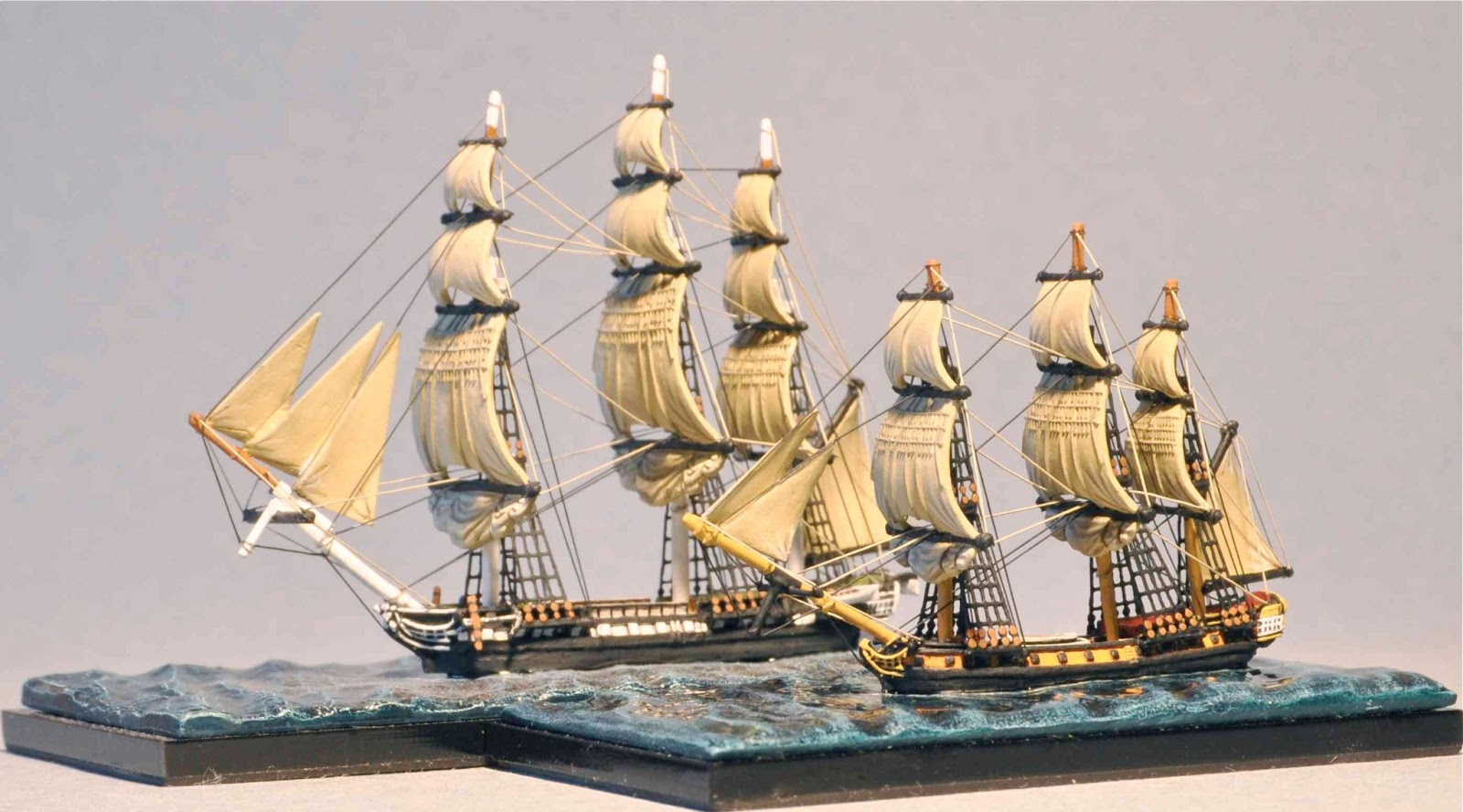
And here, for the sake of size comparison, is a nightmare scenario from the War of 1812. He would be a brave British captain indeed who would engage the USS Constellation with such a vessel. Though the Constellation is nominally a 38 gun ship, as opposed to Cleopatra's 32 guns, the differences in fire power are more significant than those numbers would imply - not to mention Constellation's advantages in hull strength. The plucky Cleopatra never engaged an American frigate, but given her record it seems many of her captains would not have shrunk from the opportunity.


Wednesday, February 27, 2013

10mm WW2 Germans - Pendraken Miniatures

With my longstanding interest in very small scale models, the Pendraken 2013 painting competition announcement caught me in a pretty vulnerable condition. In addition to the late Roman infantry of the post below, I decided I would also paint up a few stands of Second World War pieces. I chose Germans because they are the most fun to paint.

These are the results of my efforts so far - a Hetzer tank hunter and two bases of late war infantry. I've tried to give the scenic elements a suitably drab look, having in mind the autumn of 1944. Each infantry base consists of three riflemen (one with a panzerfaust) and a noncom with an stg 44. I've tried to give a suggestion of camouflage on some of the uniforms, without going too too far out of scale.

I hope in time to expand on this small force, though there are a couple other projects ahead of it in the queue. It's an enticing subject of course, and I like the Pendraken offerings a lot. The detail is decent, considering the 10mm scale, and they are pretty inexpensive. That's a big plus when considering whether or not to embark on a whole new project.