Thursday, October 25, 2012

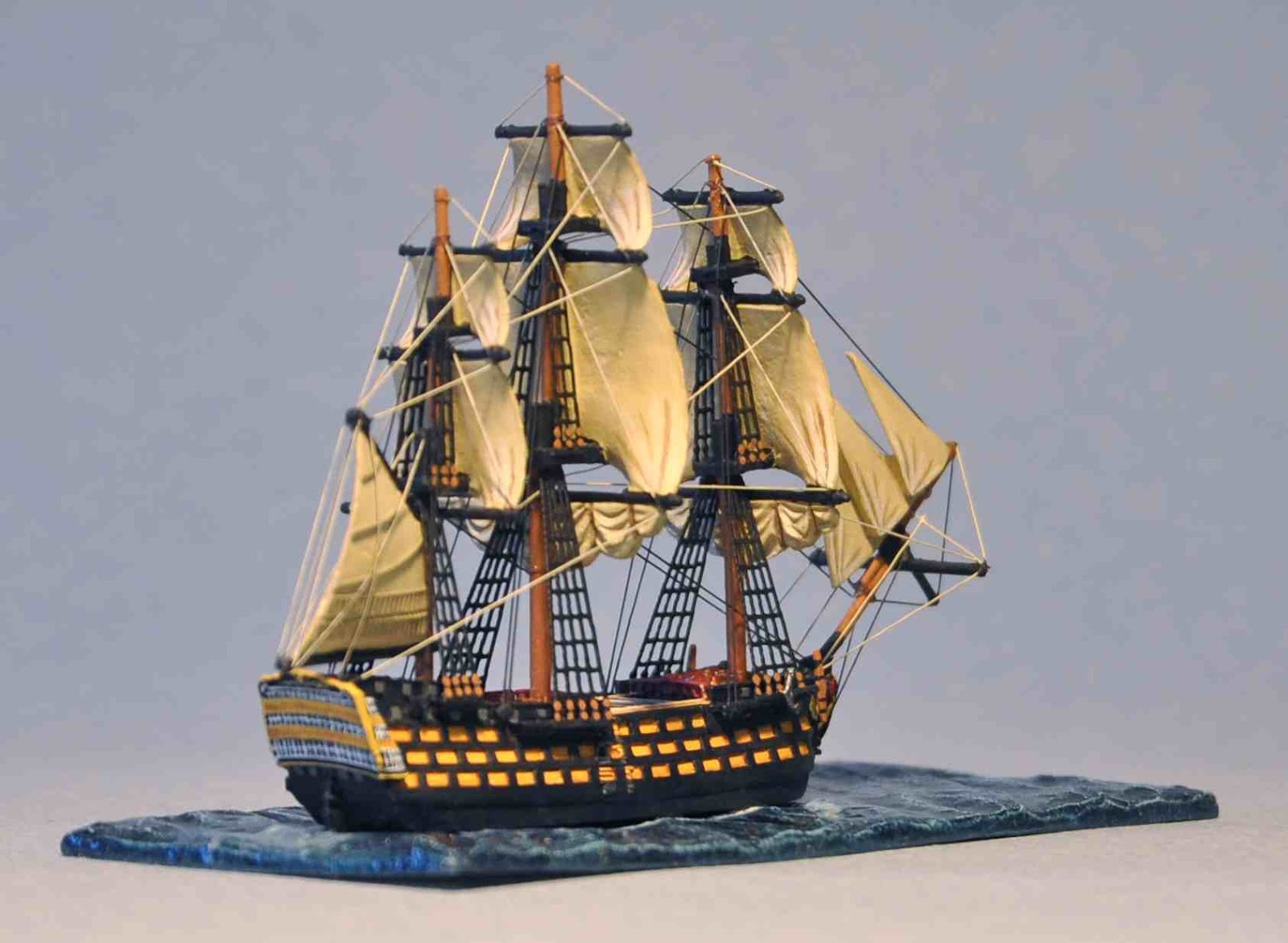
Santissima Trinidad - GHQ 1:1200


The latest project off my painting table is GHQ's 1:1200 model of the famous Santissima Trinidad, the great lumbering Spanish behemoth that perished in the aftermath of Trafalgar.

Once again I have copied the National Maritime Museum's (Greenwich) excerpt from Dr. Colin White's (no relation to myself) 'The Nelson Encyclopedia.'

The most famous Spanish warship of her day, the Santissima Trinidad played a central role in two of Nelson's battles. With her four gundecks mounting a total of 136 guns, she was reputed to be the largest ship in the world, a claim often repeated subsequently by historians. In fact she was appreciably smaller than the French three-deckers launched just before the war.


 Built in Havana in 1769 to the designs of the Irish naval architect Matthew Mullan, the Trinidad was originally a standard three-decked battleship, mounting 116 guns. In 1795 her forecastle was joined to her quarterdeck, and a light battery of eight pounder guns mounted, thus creating her distinctive 'four-decker' appearance. But although this change made her look most impressive, it also considerably worsened her sailing qualities and her stability. So she tended to be a liability in battle, rather than an advantage.


 Trinidad was also an obvious 'trophy' and the British made very determined attempts to capture her. At the Battle of Cape St Vincent, 14 February 1797, where she was the flagship of the Spanish commander in chief, Teniente General José de Córdoba, she came under attack from at least five British battleships including briefly, Commodore Nelson in HMS Captain. After a heroic defence in which she was totally dismasted and suffered over three hundred casualties, she surrendered. But before the British could take possession of her, the commander-in-chief Admiral Sir John Jervis was forced by the arrival of fresh Spanish ships to break off the action. The Trinidad's crew managed to rig jury masts and bring their battered ship safely into Cádiz harbour, despite a gallant attempt to recapture her by the British frigate HMS Terpischore under Captain Richard Bowen.


Eight years later however, Trinidad was less fortunate. At the Battle of Trafalgar, 21 October 1805, flying the flag of Rear-Admiral Don Baltazar de Cisneros, she was once again set upon by a concentration of British ships and eventually surrendered to HMS Neptune, commanded by Nelson's close friend Captain Thomas Fremantle. HMS Prince took her in tow, but she had been so badly damaged that she sank in the great storm that followed.


For the sake of size comparison, here is a shot of Santissima Trinidad between HMS San Josef (116 guns) and HMS Centurion (50 guns). San Josef's main mast is the same size as ST's fore mast. 


And here is a hypothetical scenario depicting a fight between Santissima Trinidad and George Washington, though the two never actually met in battle. 


Tuesday, October 2, 2012

6mm French Artillery, Seven Years War

Here is another Baccus Miniatures 6mm subject from the Seven Years War - a french artillery piece with its crew. Nicely detailed little figures, considering the size.


This is the entire army at this point - a humble beginning, but it's slowly growing:


Monday, October 1, 2012

HMS San Josef - GHQ 1:1200

Below are some photos of GHQ's 1:1200 HMS San Josef, a 112 gun first rate ship of the line built by the Spanish, and the terminal point of 'Nelson's Patent Bridge for Taking First Rates' - a humorous phrase referring to the circumstances under which Horatio Nelson, commanding HMS Captain at the Battle of St. Vincent, captured the San Josef. I hope I will be forgiven for copying the National Maritime Museum's (Greenwich) excerpt from Dr. Colin White's (no relation to myself) 'The Nelson Encyclopedia. It will make much better reading than any summarizing on my part. 


The San José was a three-decked Spanish first-rate battleship of one hundred and twenty guns, built in the northern Spanish port of Ferrol to the designs of the French-born naval architect Franciso Gautier in 1783. On 14 February 1797 she formed part of the Spanish fleet at the Battle of Cape St Vincent, when she flew the flag of Rear-Admiral Don Francisco Winthuysen. She was in the thick of the fighting and suffered badly from the heavy British broadsides. Over one hundred and fifty of her crew were killed or wounded, including her admiral who lost both legs and was carried below to die.

At the height of the action the San José was rammed by her next astern, the eighty-gun San Nicolas and the two ships became locked together. It was at this point that Nelson made his famous move, leading a boarding party onto the San Nicolas and capturing her by storm. Seeing the plight of their comrades, the Spanish in the San José tried to help them by firing on Nelson's men, only to find themselves assailed in their turn. This further blow was too much for an already demoralised crew and moments later, a dazed Nelson found himself receiving the surrender of all the Spanish officers on the quarterdeck of the San José. He handed their swords one by one to one of his barge's crew, William Fearney, 'who put them with the greatest sang froid under his arm'.
San José actually enjoyed a long active service in the Royal Navy as HMS San Josef – the only foreign first-rate battleship ever to do so. Her first service was as Nelson's flagship in the Channel in January 1801. Some of Nelson's biographers have suggested that this was done as a special compliment to him, and he certainly asked if she was available. But the most likely explanation is that she was brought into service hurriedly as a replacement for the British first-rate Queen Charlotte, which had been accidentally destroyed by fire the previous year. San Josef remained in active service and after Nelson's death, her association with him meant that she was preserved long after her useful life was over. She lasted until 1849 and when she was finally broken up, much of her wood was made into furniture and other relics.


And here is the San Jose very, very late in life, in a photo published in 'The Royal Naiy in old Photographs' by Wilfrid Pym Trotter. M. C. Naval Institute Press


Thursday, September 20, 2012

6mm French Line Infantry from the Seven Years War - Baccus Miniatures

For the first time I've tried my hand at some 6mm figures from Baccus Miniatures, French infantry from the Seven Years War. I was very impressed with the level of detail of these figures and, being one who likes to lavish all the attention I can bear on the things I paint, there was plenty here to keep me busy. The kit includes printed paper flags of various units, and I have modeled the Boulonnais Regiment here.

For such small sculpts, the bayonets are actually quite sturdy, and there seems little danger of them bending or breaking off unless they are really strongly abused. I've actually shaved them down a bit, as I felt they were at first too clunky and broad. Even so they remain strong.

The 24 figures of the unit sit on a 30mm X 60mm plywood base from Lithko, which I've just given a very basic terrain treatment, and I really like the effect  from a moderate distance. See the last photo for a size comparison.


Tuesday, September 18, 2012

USS Constellation - GHQ 1:1200


Below are some photos of USS Constellation in 1:1200 scale, from GHQ. This is the famous 38 gun American frigate of the Napoleonic War/ War of 1812 period, and should not be confused with the ship which lives down in Baltimore now - that one is a later construction, from the 1850s if memory serves, and supposedly contains some of the timbers from the ship depicted below. Or at least it did at the time of its construction.

I really like the incredibly crisp hull sculptings from GHQ, and especially the fact that the waist of the ship is properly recessed. This model even has details of steps leading down in to the waist, and hatches with gratings down there, as you can see best in the last photo.

I've added Langton ratlines and sea base, and raised the hull up on plastic sheet to give it more bulk, so it will fit in a little bit better with Langton models, which tend to be over-sized in comparison. Other than that a pretty straight forward job.


I omitted installing ship's boats in the waist, just because I like to be able to see the detail down there. I like the depth it gives the model, and it suggests an interior.


Tuesday, July 24, 2012

HMS Centurion - GHQ 1:1200

The latest ship I've completed is GHQ's 1:1200 HMS Centurion of 50 guns. I've raised it up just a little bit with some plastic sheet under the hull, cut to the contour, and added third party ratlines and base. The bowsprit has also had a spritsail boom and a dolphin striker added to it, as the kit does not come with them. 


 Here are a couple shots of Centurion alongside Superbe, a French 74, to give a sense of the difference in size.


Monday, July 16, 2012

Le Superbe - GHQ 1:1200

Below are a bunch of pictures of GHQ's 1:1200 model of Le Superbe, a French 74. Even in this small scale this is an uncommonly attractive ship - even as just a water line model I find its lines more graceful and appealing than most. It was also nice to get away from yellow and black checkers for a bit!

It is particularly satisfying for me to see this one completed. I had just completed the rigging for the first time when it took a tumble off the table. The rigging performed its function and the masts were unharmed, but the cords were stretched and no longer taut. Turns out rigging is even more stressful the second time around. But it's done!